ReInsVLN
Training-free vision-language navigation
ICRA 2027 · Submitted
Retain useful visual evidence, then help frozen navigators use it at the right moment.
- My role
- Second author · Core contributor
- Methods & tools
- PyTorch · StreamVLN · InternVLA-N1 · Habitat / R2R
01
Problem & challenge
Growing histories introduce redundant visual context, while retained landmarks can remain unused in navigation decisions.
02
Key contributions
My contribution
Led early exploration and integration of visual compression, contributed to its implementation, and collaboratively refined memory selection. Collaboratively built the high-level / low-level coordination framework, adapted multiple VLN models, and connected model inference to robot execution. Deployed models on Go2 and G1 and contributed to robot experiments.
Method
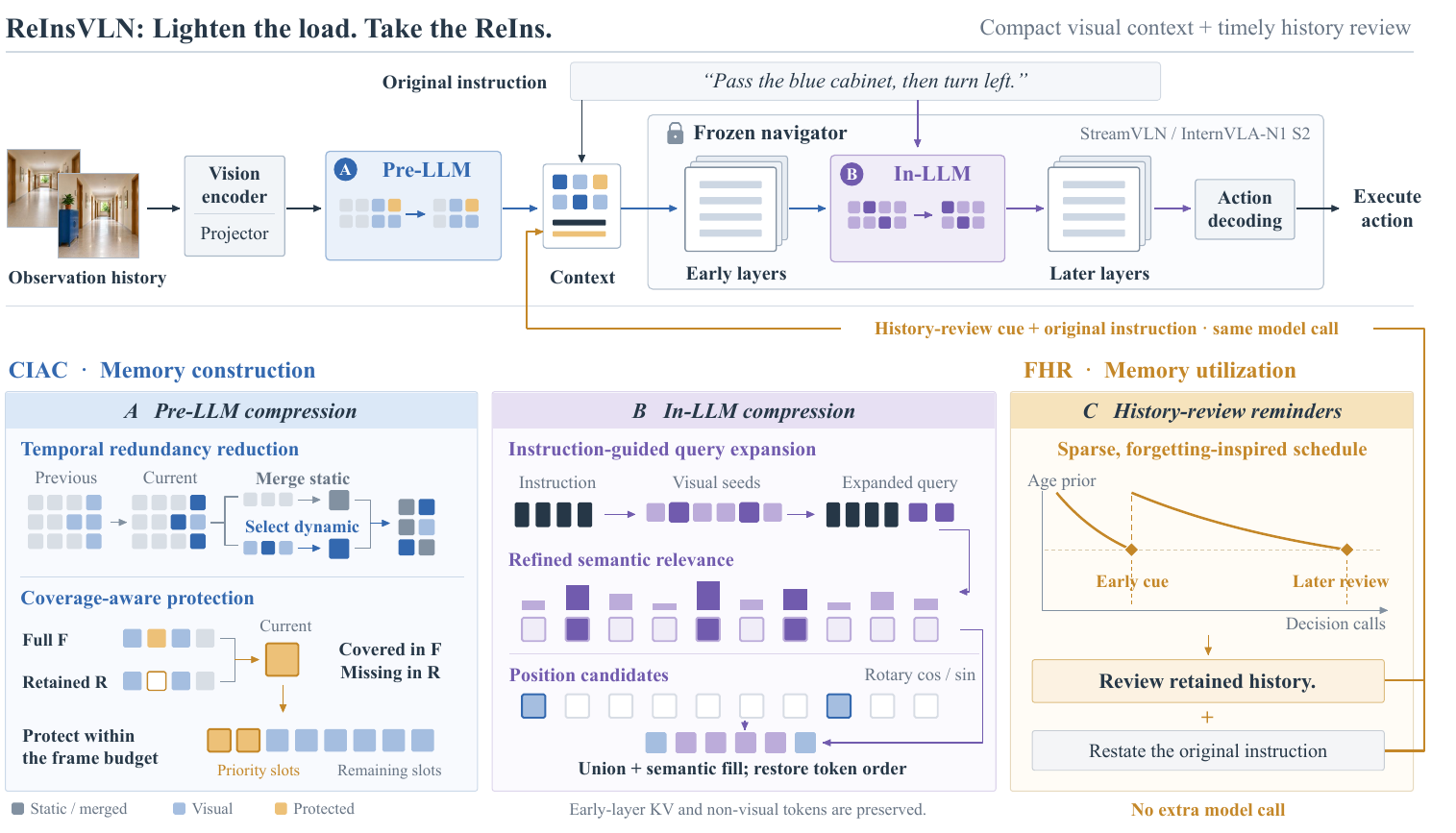
Compress observation history before the language model, reducing temporal redundancy while protecting poorly covered content.
Select visual tokens inside the language model using instruction relevance and position, then restore their original order.
Add scheduled history-review cues and connect native navigation decisions to robot execution.
03
Experimental results
On all 1,839 R2R Val-Unseen episodes, StreamVLN / InternVLA-N1 reach 64.27% / 64.44% SR, gains of 8.48 / 3.37 percentage points. On matched observation workloads, the InternVLA-N1 compression configuration reduces prefill latency by 21.77% and KV storage by 32.25%.
Research in progress; code and manuscript are not public.