Yongjiang Laboratory / Imou
Built a weakly supervised anomaly-detection and VLM-verification pipeline; QLoRA tuning of Qwen3.5-VL improved ECVA test accuracy from 65.68% to 78.53%.
RESEARCH PROFILE · UPDATED 27 SEP 2026
Embodied AI · Multimodal Learning · Model Compression
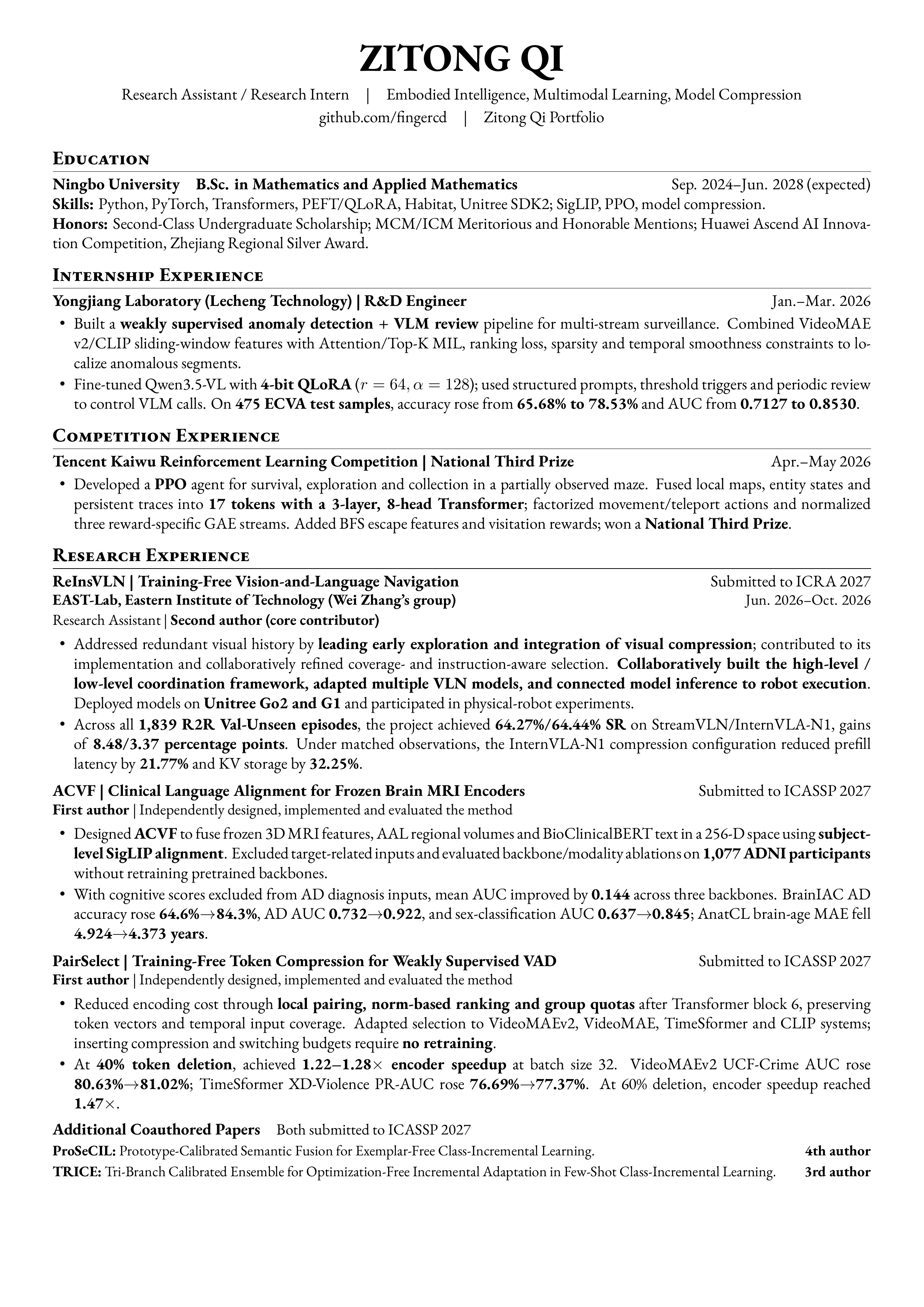
I am an undergraduate in Mathematics and Applied Mathematics at Ningbo University (2024–2028). I previously worked as a research assistant in Prof. Wei Zhang’s group at EAST-Lab, Eastern Institute of Technology. My research focuses on embodied intelligence, multimodal learning and model compression. Previous experience includes video-analysis R&D at Yongjiang Laboratory and remote research at TReNDS Center, USA.
Built a weakly supervised anomaly-detection and VLM-verification pipeline; QLoRA tuning of Qwen3.5-VL improved ECVA test accuracy from 65.68% to 78.53%.
Conducted ACVF research on multimodal brain MRI, including method design, implementation, cross-backbone experiments and modality ablations.
Designed a 17-token Transformer policy and PPO training with three value estimates, GAE, BFS escape features and rewards for survival, collection and exploration.
Worked on ReInsVLN: led early exploration and integration of visual compression, contributed to its implementation, collaboratively built high-level / low-level coordination, deployed models on Go2/G1, and participated in robot experiments.
My contribution: Led early exploration and integration of visual compression, contributed to its implementation, and collaboratively refined memory selection. Collaboratively built the high-level / low-level coordination framework, adapted multiple VLN models, and connected model inference to robot execution. Deployed models on Go2 and G1 and contributed to robot experiments.
Project results: On all 1,839 R2R Val-Unseen episodes, StreamVLN / InternVLA-N1 reach 64.27% / 64.44% SR, gains of 8.48 / 3.37 percentage points. On matched observation workloads, the InternVLA-N1 compression configuration reduces prefill latency by 21.77% and KV storage by 32.25%.
My contribution: Independently designed and implemented fusion of MRI, AAL regional volumes and BioClinicalBERT text, using subject-level SigLIP alignment with frozen backbones and cross-backbone ablations.
Project results: For AD classification excluding cognitive-score inputs, average AUC improves by 0.144 across three backbones. BrainIAC accuracy rises from 64.6% to 84.3% and AUC from 0.732 to 0.922. AnatCL brain-age MAE decreases from 4.924 to 4.373 years.
My contribution: Independently developed local pairing, norm ranking and group quotas after Transformer block 6. Adapted four detector systems without retraining for compression or budget changes.
Project results: On UCF-Crime / XD-Violence at batch size 32, 40% token deletion yields 1.22–1.28× encoder speedup. VideoMAEv2 UCF AUC rises from 80.63% to 81.02%; TimeSformer XD PR-AUC rises from 76.69% to 77.37%. At 60% token deletion, the encoder reaches up to 1.47× encoder speedup.
Prototype-Calibrated Semantic Fusion for Exemplar-Free Class-Incremental Learning
Tri-Branch Calibrated Ensemble for Optimization-Free Incremental Adaptation in Few-Shot Class-Incremental Learning
I use Python, PyTorch, Transformers and PEFT/QLoRA for model training and adaptation, with experience in SigLIP contrastive learning, PPO, weakly supervised MIL and visual-token compression. My work includes Habitat/VLN-CE evaluation, Unitree SDK2 integration, and brain-imaging pipelines with MONAI and NiBabel. Engineering tools include OpenCV, FastAPI/Flask, SQLite, NumPy/pandas, scikit-learn/XGBoost, Linux/SSH and web interfaces.